Mitigation banking and ESG engagements front-load their milestones, then run years of quiet monitoring work that standard tracking views can't surface. That gap is where margin erodes unnoticed, until a client forces a reckoning. EVX Software keeps cost, time, and status visible continuously, flagging projects that go quiet, so nothing depends on someone remembering to check.
A mitigation banking or ESG engagement rarely starts quiet. Site selection, instrument negotiation, initial restoration or baseline assessment work, this front end is dense. Deliverables land close together, milestones are visible, and a project manager can see the whole shape of the work in one glance.
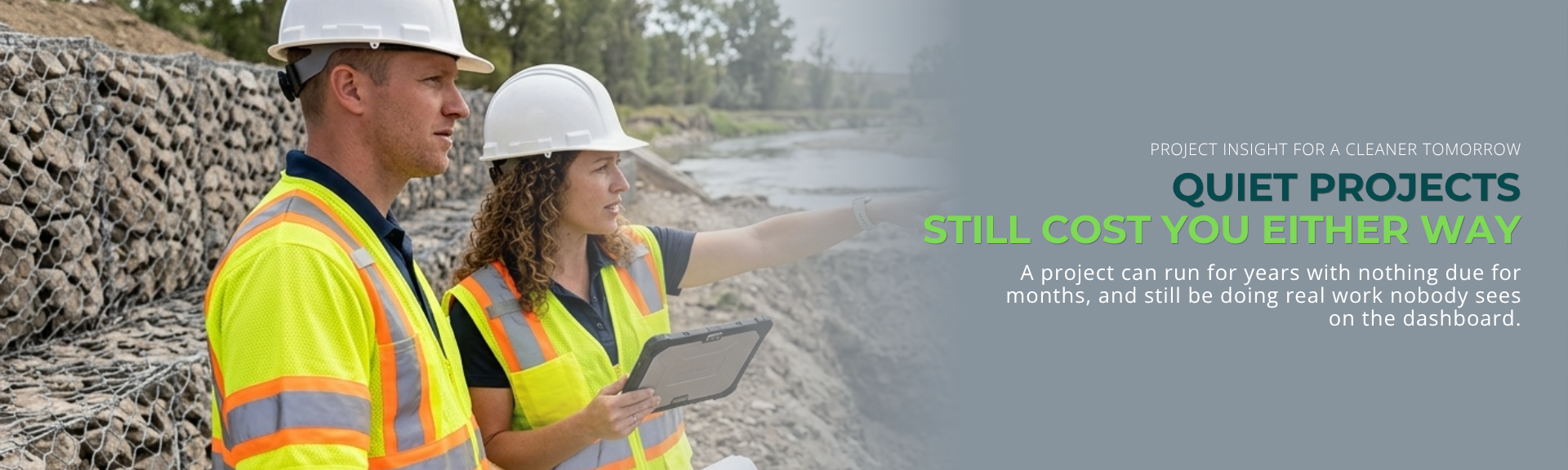
Then the active phase ends and the long middle begins. Credits are released in stages tied to monitoring milestones, not all at once. Reporting runs on its own calendar, often annual, sometimes longer. A firm can be years into an engagement with nothing due for months and still be doing real work: a site visit, a data pull, a compliance filing. The project hasn't stalled. It's generating real activity that doesn't look like progress on a standard project view, and that gap is where things start to go wrong.
Most project tools treat a milestone as a point, not a span. That works when milestones sit close together, and the work between them is dense enough to fill a dashboard. It breaks down when the real story is what's happening in the gap, not the gap's endpoints.
The practical result: a project a year into a monitoring phase doesn't show up next to whatever's due this week. It isn't hidden on purpose. A recency-driven, milestone-driven view was never built to surface something quiet and ongoing, so it doesn't, and nobody decided that on purpose.
This isn't a data problem. Most firms running long-horizon engagements have what they need to know exactly where a project stands: cost against budget, hours logged, the last monitoring report, the next filing deadline. What's missing is those pieces converging anywhere one person can see the whole picture at once. A monitoring update lives in one inbox. A cost figure lives in the accounting system. The original scope sits in a proposal document nobody has reopened in two years.
A quiet, on-schedule project doesn't compete for attention against a loud, active one. Nobody investigates silence. It gets assumed to mean the project is fine, right up until something forces a real look: a milestone, an invoice that doesn't match what the client expected, a report due where the last one flagged something nobody followed up on.
By then the gap between what was tracked and what actually happened isn't an internal correction anymore. It's a conversation with the client, and it starts from a position of having missed something they didn't.
The fix isn't a heavier review process. A monthly checklist or a standing calendar reminder still depends on someone remembering to look, on a specific day, at a project that gave no sign it needed attention. That's the same blind spot with more steps in front of it.
First, every active project, regardless of phase, needs a line on one shared view showing current cost against budget and days since last activity. Not a separate report someone runs. Something visible by default, in the same place as every other project, including the ones due nothing this month.
Second, that view needs to flag projects on its own once they cross a threshold: no activity or no cost update past a set number of weeks, so it surfaces the quiet ones instead of waiting for someone to think to check. A monitoring-phase project that hasn't had a cost entry in ten weeks should look different on the dashboard than one updated yesterday, without anyone having to compare the two by hand.
This is what EVX Software does for a long-horizon engagement: time, cost, and task status feed one shared project view continuously, not just at the points where a milestone forces someone to look. A project that's ten weeks into a quiet monitoring stretch shows exactly that: current cost, last activity date, days since anything moved, in the same view as every other project the firm is running. Nobody has to remember to open a separate report to see it.
That doesn't shorten the years-long middle of a mitigation or ESG engagement. It changes what happens during it. A project stops depending on someone's attention finding it in time.
.png)
.png)